YouTube/Ascendents Net (Jan-9) shared (playlist), "2025 January L.A. Fires," playlist for YouTube (includes: MSNBC, CNBC Television, NBC Chicago, NBC 10-WJAR, Sky News, BBC News, AXN News, Teleport.camera, and others).
(2025-Jan-9 12:44am) PowerOutage.us California (2025-Jan-8 afternoon) NASA Worldview, asc.cool/?sY
Democrats suggested the fires were caused by climate change. Republicans on X blamed California's leadership and called for resignations. The wildfires caused temperature variations amplifying extreme winds, creating more fires. Some arsonists used the opportunity as a cover to start more fires.
(1917) "Wake up America! Civilization calls every man, woman and child!," by James Montgomery Flagg via U.S. Library of Congress asc.cool/?g
Being so driven and determinedto play a show with local band, The Dandy Warhols, The Ascendents' drummer Timmy and bassist Josh had given away their souls to the Dandy Warhols."THEY GAVE THEIR F---ING SOULS TO THE DANDY WARHOLS!" Kyle commented with extreme contempt and disappointment, "other past Ascendents souls also were lost to the Dandy Warhols," and referenced an earlier Ascendents' drummer from long, long ago.
(1918) "Don't talk, the web is spun for you with invisible threads, keep out of it, help to destroy it--spies are listening," via U.S. Library of Congress shorturl.at/jBUDu
Kyle added, "we are the better band, are they going to headline us? By the way, for that kind of style: compared to The Dandy Warhols, The Brian Jonestown Massacre sounds more--" a fight interrupted.
The two rival West Coast "psychedelic" rock bands had somehow polarized/split The Ascendents' fanbase(A.K.A. the entire human race). Kyle shouted, "I demand 10 million-billion dollars (contribution) from each and every one of them!"Everyone was out and in it for themselves. Reaching to the highest ground, Kyle had exclaimed, "whatever happens, I hope that it is my best!" Timmy had replied, "actually, I hope that too, lol!" From Josh, no comment was provided (classified). Kyle had pushed the narrative that Josh's soul was probably too busy being tortured while trying to get through The Dandy Warhols - The Best Of The Capitol Years: 1995-2007 album.
"S & H green stamps," by artist Andy Warhol, "exhibit at the Institute of Contemporary Art, Philadelphia, 1965." via U.S. Library of Congress shorturl.at/ayR5A
Eventually, as the years passed, it became more obvious (via Reddit) that the BJM (The Brian Jonestown Massacre) actually was a lot more-preferred than the Dandys, but even through the year of 2024, Josh and Timmy were still overly committed and possessed, all day and every day, fantasizing and thirsting, for the possible dream, of one day, playing a "show"... with the Dandy Warhols. They wouldn't come down. Their poor, unfortunate, and blinded "Dandy-sipping" souls didn't care about their own band, only the Dandy Warhols. Instead of pushing for the next Ascendents album, Josh and Timmy prioritized going to Dandy Warhols concerts: to be top #1 Dandy fans, to maybe see someone top-less, and to try talking about that great shining "dandy" gig on the horizon. Kyle shared a link, "340 minutes (80 songs) of Anton Newcombe and The Brian Jonestown Massacre." He summarized, "their hunger for power was over. It wasn't a bed of roses or a pleasurable cruise. It was like getting sand kicked in my face, but we didn't lose. This is a victory for all of the free world." Then, Kyle shared a special (Raw Sessions) version of Queen's "We Are The Champions."
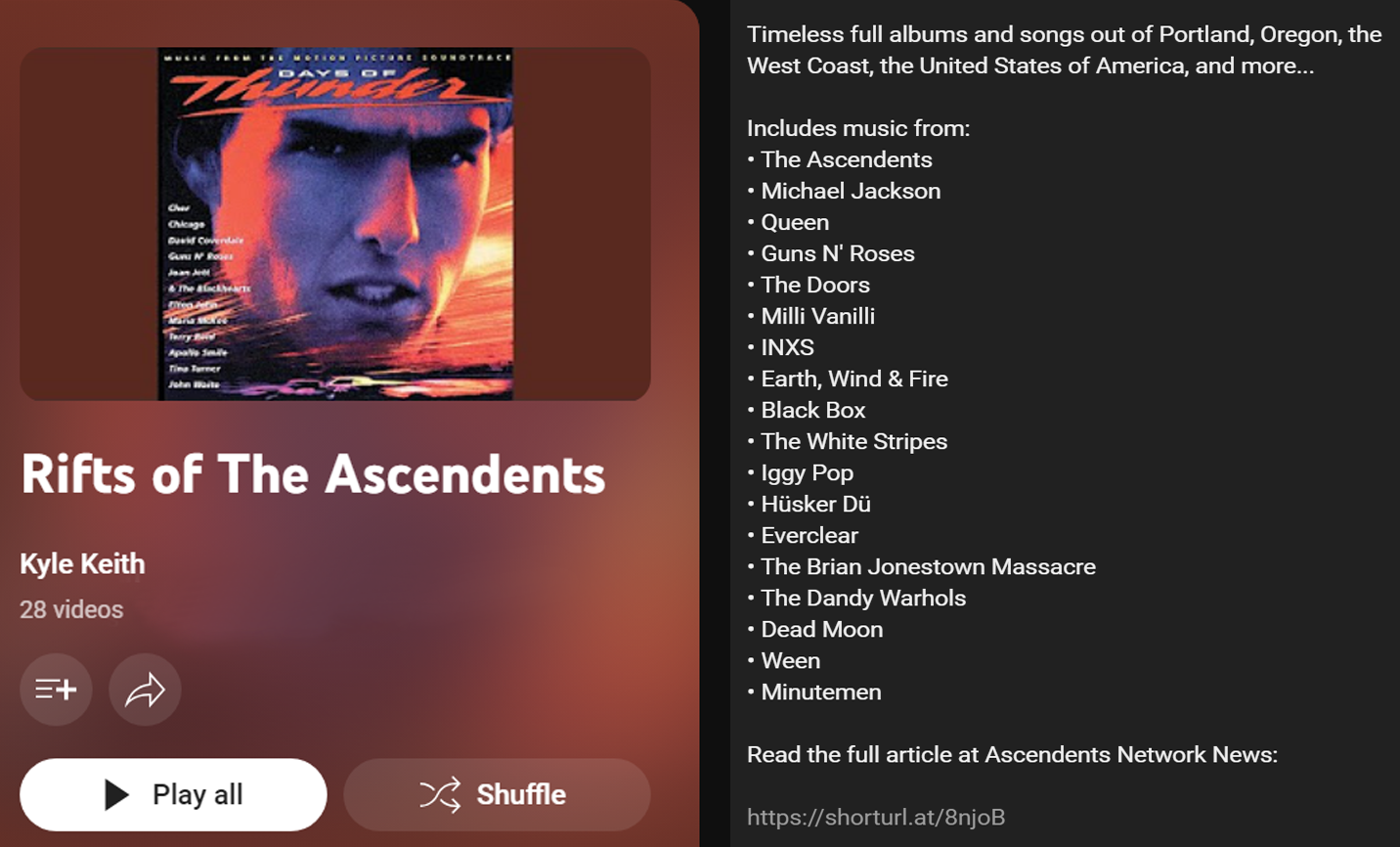
"Rifts of The Ascendents" YouTube Playlist by Kyle Keith - (28 videos) Play all | Shuffle — "Timeless full albums and songs out of Portland, Oregon, the West Coast, the United States of America, and more... Includes music from: The Ascendents, Michael Jackson, Queen, Guns N' Roses, The Doors, Milli Vanilli, INXS, Earth Wind & Fire, Black Box, The White Stripes, Iggy Pop, Hüsker Dü, Everclear, The Brian Jonestown Massacre, The Dandy Warhols, Dead Moon, Ween, and Minutemen. Read the full article at Ascendents.net News."
This article is continued from previous article, Space: Ascendents Sphere of Stars (AAC-1). There are questions of if it's accurate to classify AAC-1 as a dome-shaped open cluster, where stars are locked in tight gravitational bound orbits, or if it's something else entirely. It's been awakening realizing how its center is extremely close, out of everywhere in the galaxy, as if humans have something to do with it. The feature is similar to a galactic stellar halo, except that it isn't, because of its center's eerie/close proximity to the Solar System. The Ascendents Sphere (AAC-1) should not be confused with the Milky Way Galaxy (AAC-10), the Milky Way Galactic Halo (AAC-11), or the Milky Way Galactic Core (AAC-12).
Dimming and distance filters show countless edge stars for one small fraction of the Ascendents Sphere (AAC-1) star dome.
For the Ascendents Sphere (AAC-1), how many star dome stars (Ascendents) there are depends on when the counting stops, because for several light years on both the inside and outside of the sphere, large stars influence AAC-1's gravity. It's easy estimate tens or hundreds of thousands of stellar objects, because a square with 100 stars dome stars, is negligible to the significant amount of stars making the entire Ascendents Sphere.
A 2000 year time-lapse photo reveals, in relation to each other, little movement of AAC-1 stars. Other than a few stars here and there, for the most part, stellar positions haven't changed. For being tiny bright dots over 900 light years away, in the grand perspective, they hardly move. Over 100,000 years, it becomes more significant as Ben Burress from KQED said, "it would take Barnards' Star (the star with the fastest proper motion in our skies [at this time]) about 350 years to move one pinky-width across the sky." Barnard's Star is one of the nearest stellar objects to Sol, it takes finer precision to measure movement for more distant objects.
A 2000-year time-lapse projection overlay photo (the year 2022 is red, 4022 is blue), revealing part of the AAC-1 star dome shows minimal stellar movement.
If there is enough inertia, perhaps the star dome, or maybe the entire Ascendents Sphere itself actually has a rotation period. Larger intervals of time could eventually drastically change the region by turning stellar features like Ptolomy's Cluster (M 7 / AAC-7) to face closer to the center or to the edge of the Milky Way Galaxy.
Ptolemy's Star Cluster (M 7 / AAC-7) is near the center of the screen. In the middle of the star cluster, visible from Earth is the Keith Star System (AAC-2).
Ptolemy's Cluster (AAC-7 / M 7) is located in Scorpio, but the actual group of blue stars are located to the right of the constellation's brightest lone stars, above Ophuchius, and left of Sagittarius. The Ascendents Sphere (AAC-1) stars might have orbits, but they don't quite appear to flow or migrate -- as M 7 is still where M 7 is. From a galactic perspective, since 2000 years ago when Ptolemy named the blue star cluster now also known as M 7 / AAC-7, the stars were almost in the same place.
The discovery of the Ascendents Sphere (AAC-1) has opened the door to a new world of questions about the nature of existence and how our individual interpretations light perspectives, inspire visions, and give us a better understanding of how everything connects. Contributions answer questions, bring peace, and create satisfaction. Postmodernism has been a threshold for a new age of thinking that can blind people to believe they already know everything, however; now it's more obvious that by taking a step back and understanding how the experts of the past, even with their limited technology, also had right perspectives; there are both -- new and old truths to be learned and relearned for the record. The Ascendents Sphere is quite the astronomical phenomenon; and for some reason with us as humans beings at the center, it seems the discovery strongly relates to anthropology (the study of humans and the human experience), as well as many other aspects to life and science.
Sagittarius dSph (AAC-13) (top-left), Milky Way Galactic Core (AAC-12) (center-left), Ascendents Sphere (AAC-1) (right)The Ascendents Sphere (AAC-1) diameter spans over 1800 light years across the 105,700 light year diameter of the Milky Way Galaxy (AAC-10)
The Keith star system (AAC-2) is a binary star system was discovered in Aug-2022, watching behaviors of closely positioned blue giant stars, C (AAC-2-1 / HD 162678) and Kyle (AAC-2-2 / HD 162679). The star system is located on the star dome of the Ascendents Sphere (AAC-1) and also is at the middle of Ptolemy's Cluster (M 7 / AAC-7).
The Keith Star System (AAC-2) is a binary star system: C (AAC-2-1 / HD 162678) and Kyle (AAC-2-2 / HD 162679).
For a star as C (AAC-2-1), whose day lasts for over 2 Earth-months, Kyle (AAC-2-2) scrambling around to accomplish an entire revolution in a 16 Earth-hour day may seem foolish. Sometimes they space each other. Neighbor stars sort-of attract them, but not so much as they are a lot more distant; others' gravitational pull, temperature, and light doesn't really have the same meaningful and direct effect.
The, "year length," for the stars to orbit each other remains unknown, orbits of binary stars have been at the edge of discovery even for the Alpha Centauri system stars (consensus for Rigil Kentaurus and Toliman orbit is every 79 years), however; for Proxima, .2 light years is a fairly significant distance for an orbit radius and is calculated at around 430 Neptune orbits of 165 Earth-years. Some orbits are faster than others, but with using that information, if C and Kyle actually orbit, it might be estimated nearly every 700 Neptune orbits (once roughly every few hundred thousand Earth-years), because if circular it has to travel about 1.88 light years; therefore the models that predict tidal lock can't be true, because it would be impossible for the stars to complete their orbit in only 72 days as they would have to be traveling faster than the speed of light.
There's an understanding that even Proxima causes precession (wobble) for the rest of the Alpha Centauri system, in 2016 Ken Croswell for New Scientist relayed from Pierre Kervella at the Paris Observatory in France, "that’s the reason why it is possible now to be sure that there is a gravitational link between Proxima and Alpha Centauri." Moreover, "the work reveals Proxima’s orbit for the first time. The star revolves once every 550,000 years on an elliptical path." Compared with Proxima being a tenth the size of Rigil Kentaurus, Kyle is about two-thirds the size of C and is considerable mass for their system's barycenter.
Being closer than other stars, C (AAC-2-1 / HD 162678) and Kyle (AAC-2-2 / HD 162679) have the greatest influence on each other.
C and Kyle are only 0.3247 light years (20,534 AU) apart, where-as Alpha Centauri (one of the brighter stars in Earth's night sky) is 4.367 light years away, over 13 times more distant. Neighboring stars are everywhere continuing about their orbits, there is a balance and they never get closer or more distant than their orbits allow. No parts of any other known stellar orbits extend to the Keith star system or get closer than the two stars. Alpha Centauri is a much dimmer, smaller, and colder star system than Keith. The two closest stars of α Cen are very close, 23 AU from Rigel Kentaurus to Toliman (α Cen B) is only the distance from Sol to Uranus.
Way back in August of 1982, research of HD 162679 (Kyle) was provided by NASA Astrophysics Data Systems and published to, Publications of the Astronomical Society of the Pacific p, Vol. 94, p. 692-694 (1982). H.G. Luna doesn't seem to mention C (HD 162678) on the opposite side of Kyle. (Kyle is closer to Sol, C is almost eclipsed, closer to the outside of the Ascendents Sphere [AAC-1]). At the time, maybe in an earlier star catalog, Kyle's closeness to C (HD 162678) star hadn't actually been discovered yet. The article itself confirmed variable polarization which had suggested it may be part of a binary system, "we conclude that while intrinsic variable polarization has been found in HD 162679, there is no satisfactory conclusion about its nature," and continued saying, "more spectroscopic, polarimetric, and photometric data with good time resolution are needed to check if a close binary system of short period is responsible for the observed variable polarization."
It's rare for small blue giants/super giants to revolve slowly, when comparing to other blue stars, C (class B9II) spins less, more like a miniature version of blue supergiant Rigel (ß Orion) (class B8I-a), where-as similar in luminosity, day-length, and surface temperature, Kyle (class B9V) is more like blue giants Algol (class B7V) and Regulus (B8IV).
C (AAC-2-1 / HD 162678) and Kyle (AAC-2-2 / HD 162679) are only 0.3247 light years (20,534 AU) apart.
It can be love/hate, because the two binary stars can't escape each other, however; there is peace in knowing that for hundreds of millions of years they are going to shine together, and comfort in knowing they share a connection and have a relationship others wouldn't understand. Even though it's difficult not to wonder if and how they could ever break orbits, there doesn't really seem to be any doubt in expecting for the stars of Keith to keep revolving.
(Near zoom): The Keith Star System (AAC-2 / AAC-1-1 / AAC-7-1) is part of Ptolemy's Cluster (M 7 / AAC-7).
The neighbor stars are not nearly as close, but they still try to throw around their weight. Maybe other stars seem jealous they don't have a stellar companion that is so bright and so close, and they are envious of spectacular views from C and Kyle; because as mentioned not only are the two stars in the center of Ptolemy's Cluster (M 7 / AAC-7), the star system is also directly on the boundary of the Ascendents Sphere (AAC-1).
(Far zoom): The Keith Star System (AAC-2 / AAC-1-1 / AAC-7-1) is part of Ptolemy's Cluster (M 7 / AAC-7).
While having more depth and being twice as luminous of a star, it isn't always about being hot on the surface even though C's surface temperature of 10,300 K is twice as hot as Sol. Somehow, for Keith's smaller star being almost half as luminious, maybe all that extra energy from spinning, seeming denser, and having less surface area are reasons why Kyle at 10,700 K is even a little bit hotter. For being so hot, they both actually are really cool stars (there are distant fast-burning stars with surface temperatures over 200,000 K). Compared with Sol's radius, they are 5.6 rSun (C) and 3.6 rSun (Kyle). Both stars are very bright -- C is 209x more luminous than Sol, Kyle is 109x more luminious than Sol.
Days revolve slowly for C and Kyle revolves over 108 times faster. Every 72 Earth-days, there is a best day. Every 16 Earth-hours there is a best hour; that is true even during their system's 72 Earth-day birthday (possibly once every few hundred thousand Earth-years [if it's also a best day]). Like for the Moon to a place on Earth, there's always a leave and an approach, a waning and a waxing, a sunset and a sunrise. Losing and winning is a cycle of existence, stars repeat their orbits and revolutions. C is a brighter and bigger star with almost twice the depth, as Kyle revolves reflecting changes all around the galaxy. Maybe they both have turns being right. As for what happens after hundreds of millions of years, see it the right way and it'll also go right.
If wondering why the larger star is C (AAC-2-1) and Kyle (AAC-2-2) is the smaller star, that actually wasn't going to be the reality, except before typing the names, they were switched at the last second, because as Kyle Keith's journey has also led to the incredible discovery of AAC-1 Ascendents Sphere [leading to the development of the Ascendents Astronomy Catalog (AAC)]; that while the blue giants burn 100x faster than the sun, it was decided for the remainder of the two stars' 100+ million year life expectancies (and forever after that), with the greater interest and presence for astronomers, C should be the bigger, brighter, better-documented, and first-mentioned Keith star. The stars' close proximity to each other raises the probability for the fate of the stars to nova, or because of their current gravitational role, supernova.
Keith star system (AAC-2), C (AAC-2-1 / HD 162678) and Kyle (AAC-2-2 / HD 162679) with Milky Way background